Erosion Control – Ineffective Methods and What Actually Works

New construction creates conditions that have the potential to cause slope destabilization, dangers to wildlife and fisheries habitats; stormwater runoff increases and results in increased sedimentation. Careful erosion control planning is required to ensure environmental stewardship and safety for generations to come.

In defining an effective approach to erosion control, one should take into consideration both the long-term effectiveness as well as financial feasibility.

The following approaches and methods of erosion control have proved to be ineffective for various reasons:
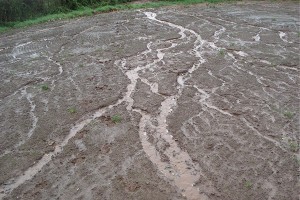
  1. rill erosion controlInadequate site assessment. Though not an end solution, the site assessment is critical when determining which method is used. When important aspects of the site conditions are not taken into consideration, inappropriate “solutions” may be prescribed.

    One example of a site condition is the steepness of the slope. The erosive forces of runoff increases with both slope gradient and distance down slope and therefore erosion is typically at it’s maximum at the lowest part of the steepest slope section. Not recognizing or taking into account the destructive force of water during seasonal runoff in scenarios with significant slope and distance will result in ongoing and increasing site erosion.

  2. A focus on sediment control (managing sediment that has already eroded) instead of focusing on the root of the erosion problem through prevention.Though silt fences and other sediment barriers may be effective in keeping stormwater and fisheries habitats from undue sedimentation, the approach should only be used temporarily. Filter socks like Denbow’s Filtersoxx can be used both as a temporary sediment barriers but also as part of a more comprehensive deployment of erosion control products.  Single application solutions, not comprehensive. These methods may provide partial or temporary results but are often not effective for the following reasons:
    • Engineered structures – Though usually immediately effective, engineered structures like block retaining walls, do not adapt to changing site conditions, can become progressively weaker over time and are often the most expensive solution. For this reason engineered structures are not always the best method of erosion control.
    • Adding rip rap to ditches to minimize/slow runoff. In some scenarios with minimal run-off, rip rap can be effective but in instances with significant water speed and sedimentation, erosion control is not mitigated.
    • Adding vegetation alone, without a structural component. Though grasses can create a groundcover that can absorb some moisture, they have no slope stabilization benefits have less effective storm water filtration ability compared to native ground cover.

Erosion Control Solutions that Work
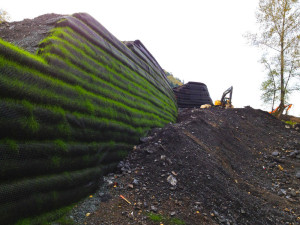
Cascadia Wall Rexford Place ProjectThe solution to these incomplete and ineffective methods is to combine them into a comprehensive bio-structural approach. This approach includes engineered structural components that are paired with natural, vegetative products that will adapt and grow within the site structure over time. Starting with expert consultation to identify the appropriate method, the following are a few combination solutions available for different applications.

  • Similar to hydroseeding, but providing much more of the underlying structure needed to prevent erosion, Terraseeding uses compost-based soils and growing mediums. During the Terraseeding process,  seed is injected directly into the soil compost mixture as the material is blown into place, providing optimum moisture and nutrient availability.
  • Denbow’s Kicking Horse Canyon Park Bridge project in Golden is an perfect example of combination solutions that utilized Terraseeded EcoBlanket and Filtrexx Rip-rap Grout installed to address erosion and to vegetate extremely steep slopes.

    EcoBlanket – On areas with a slope of 50% or less, EcoBlanket is uniformly applied directly at the soil surface with a pneumatic blower as specified by Rexius. Typically applied at a depth of 1 to 2 inches, but application depth can vary depending the site requirements. In extreme conditions and where specified by the Engineer, EcoBerms or FilterSoxx may be added and constructed at the top of the slope and in parallel intervals down the profile of the slope if necessary.
  • Extreme slope erosion may require a natural retaining wall solution for reinforcing slopes like Cascadia Green Wall, which allows for natural buffer zone design and water gardens. It is a cost effective solution when compared to concrete, block, gabion retaining walls.

Contact Denbow for an erosion control solution that stands the test of time.

Save

Save

Rain Gardens at Tsawwassen Mills

Erosion Control vs. Sediment Control

The overarching principle of Erosion Control vs. Sediment Control is that it is much easier and cheaper to prevent erosion from occurring in the first place than to try and remove the sediment once it has eroded.

Erosion and Sediment Control is a rapidly changing field. Traditional approaches have been applied with varying levels of success over the years. In addition, there are a host of new approaches, practices, and proprietary products that should be shared, understood, and considered on construction and municipal sites. Sites can be sustainably managed by minimizing the impact of earthwork using proven erosion and sediment control measures..

Erosion Controls are source controls designed to prevent erosion from occurring. Solutions include seeding solutions like hydroseeding and terraseeding, wood chip mulch and rolled erosion control products.

Sediment Controls are downstream controls designed to remove sediment from runoff. Solutions include sediment fences and barriers, filter socks and other forms of mechanical filtration.

At the detailed design stage impacts can be minimized through efficient earthworks and erosion and sediment control measures. It is vital that development be successfully completed in balance with the natural environment.

The Erosion and Sediment Control Association of British Columbia is a non-profit organization is dedicated to increase the level of expertise in the Erosion & Sediment Control field throughout British Columbia. Their list of Best Management Practices are divided into Erosion Control and Sediment Control solutions that we think you will find useful.

Mandated Green Roofs in Toronto. Is Vancouver Next?

Green roofs have many benefits. They not only insulate the buildings they shelter but also improve air quality and reduce runoff, easing sewer system loads and preventing associated overflow. They cool in summer, reduce heat loss in winter, and can support birds and other wildlife. Where green roofs top public buildings, they create public green space and parkland. Living roofs can even help cool an entire city in the summer by reducing what’s known as the “urban heat island effect,” where traditional roofing and paving materials increase the overall temperature of the air.

With Toronto’s new Green Roof Mandate, it is well on its way to becoming Canada’s Emerald City. Thanks to a City of Toronto bylaw that requires green roofs on new construction, green roofs will see a dramatic rise in Toronto’s skyline. Residences, commercial and institutional buildings over 2,000 square meters must have a roof that’s 20-60 percent “living.” Green/living roofs are partly or completely covered by vegetation, planted into a growing medium and sitting over a waterproof membrane. They often include structural support, irrigation and drainage systems, and can even incorporate greywater treatment ponds.

With the living roofs, much of the rain fall will now be “absorbed” into the plants and lessen the burden on waste water treatment and storm water volumes. For the city of Toronto, this means that there will be four to five more beach days. That’s good news for everyone. The question for us in City of Vancouver BC is, are we next?

Read the article here.

Why Sustainable Development Goals Matter

Why Sustainable Development Goals Matter

As our neighbourhoods grow, and our needs as communities increase, development and ingenuity bring solutions to people today. The key to ensuring our solutions are long-term is found in the way we do development.

Why sustainable goals matter is simply, Sustainable Development involves a relationship between nature and humans that demonstrates respect for both. Though we may not always notice it, the natural environment provides a great deal for us, and at times needs some corrective procedures to continue providing for us in the future.

We can see how our relationship to nature is give and take. The Eco-System naturally produces rainfall, provides crops to farm, and protects humans from the elements. At times, for a variety of reasons, this system breaks down and human intervention is needed. Sustainable Development is a balancing act where both parties work together for one common goal, and without it, things begin to fall apart.

Denbow seeks to use innovation to work within this balancing act. Our team specializes in construction, agriculture, landscaping, and municipal/infrastructure, all of which use sustainable development techniques. An example of this is found in Denbow’s newer work in the areas of erosion and sediment control, using forest residuals. 

One of the many products Denbow offers is manufactured soil. A mixture of minerals, liquids, organic matter and countless organisms, without healthy soil, the elements would be stripped and the land eventually destroyed. Soil holds everything together, and the right soil for the right project makes all the difference.

At Denbow, we use high quality blended soils that are produced with stringent guidelines for different kinds of use. This mixture of engineered soils can be used for a few specific purposes:


  • Vegetable Garden Soil is rich in organic matter. Using this soil in your garden will help you grow the best, healthiest vegetables each season. Growing your own vegetables can give your family the vitamins and minerals our bodies need.  
  • Specialty Soils are proprietary blended. These are used for such projects as green roofing, structural soil for street tree growth and stormwater management. The structure of these soils are custom made and vigorously tested. Sustainable development projects often require creative measures, and specialty soils provide the perfect opportunity to meet the needs of the specific projects.
  • Manufactured Soils are premium blends that contain various levels of compost and sand, designed to benefit trees and shrubs, turf health, and to rejuvenate depleted existing soil. Using these soils can restore existing greenery, or provide an important start for new growth.

Within the variety of soil produced by Denbow, we see how sustainable development starts in our own backyard. Using naturally produced materials, we can benefit from their use as we return them to the earth in our different projects, neither harming human nor the environment.

Denbow Innovations are full of products and services for sustained developments located in the Lower Mainland of British Columbia.

Phone for more information (888) 933.6269

” Delivering Satisfaction for Industrial, Government, Commercial and Residential Use”

Telus Garden Sustainable Development

Sustainable Development: TELUS Garden Receives LEED Certification

Sustainable Development: TELUS Garden Receives LEED Certification

Following an extensive review, the Canada Green Building Council awarded TELUS Garden Leadership in Energy and Environmental Design (LEED) Platinum certification. This is the highest rating a building development can receive. This honour was presented at today’s launch of the Smart Prosperity initiative at TELUS Garden, attended by Prime Minister Justin Trudeau.

Some of the leading edge sustainable development features of the building complex included:

  • 10,000 square feet of outdoor meeting space and garden terraces on six levels planted with a community food garden that will be tended by TELUS team members, indigenous trees and hundreds of plants species;
  • A district energy system that will reduce demand from conventional energy sources by 80 per cent and reduce carbon dioxide emissions by more than one million kilograms a year.
  • High-efficiency motion sensor lighting to significantly reduce energy consumption;
  • Advanced building systems, which include a ventilation system providing fresh air to residents and workers, rather than the recycled air typical of towers

Ian Gillespie, President of Westbank, which partnered with TELUS in this development project stated, “The LEED Platinum certification embodies our commitment and dedication to create a world class development where the sustainable design not only mirrors the culture and values of TELUS team members but also the tenants and businesses who have now become a welcomed part of this environmentally conscious community.”

To learn more about about this ground-breaking development, read the original press release here.